

You press the button, the door starts going down, gets a few inches from the ground, and bounces right back up. Or it reverses immediately without even trying to close. Either way, it's frustrating - and it usually means one of four things, most of which you can fix yourself in under 10 minutes.
The 4 Most Common Causes
Safety Sensor Misalignment
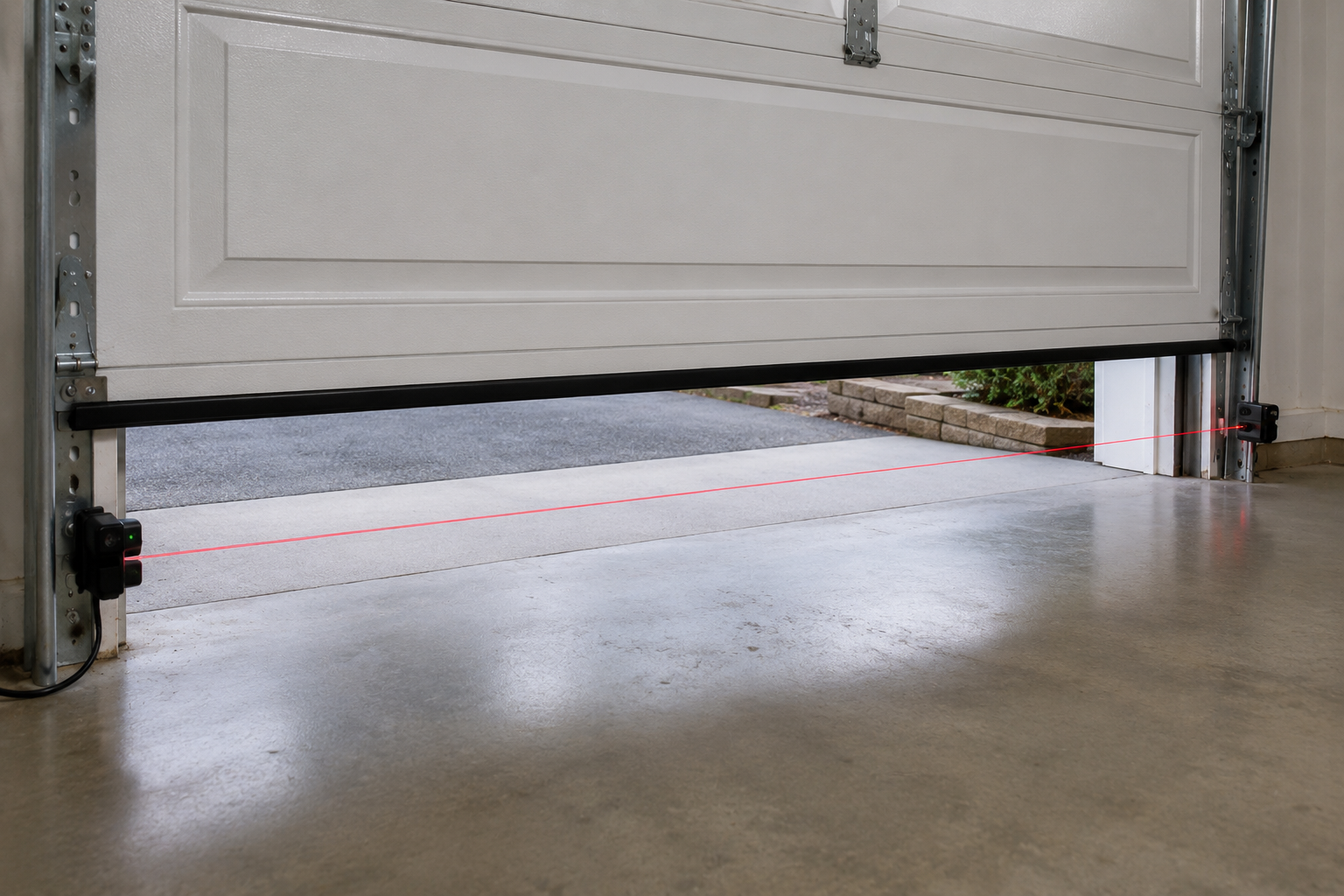
Every garage door opener made after 1993 has two safety sensors near the floor on each side of the door frame. They send an invisible beam across the opening. If something breaks that beam - or if the sensors are knocked out of alignment - the opener assumes something is in the way and reverses.
Look at the sensors. Both should have a steady light. If one is blinking or off, it's misaligned or blocked. Gently re-aim the sending sensor (usually amber) until both lights go solid.
Fix it yourself: realign sensors, clear any dirt off the lens, check the wiring hasn't been pulled loose.
Close Limit Set Too High
Openers have a "close limit" setting that tells the motor how far down to travel before stopping. If this is set too high, the door hits the floor and the motor keeps trying to push - it interprets the resistance as an obstruction and reverses. You'll notice the door seems to touch the ground but then pops back up.
Fix it yourself: adjust the close limit screw on your opener unit (usually labeled "down" or "close" with a small dial). Turn it slightly toward "more" travel. Check your opener's manual for the exact location.
Force Sensitivity Set Too Low
Openers also have a force sensitivity setting that controls how much resistance it takes before the door reverses. If this is set too sensitive, even minor friction from a stiff spring or dirty track can trigger a reversal. This is a safety feature that can be accidentally adjusted or drift over time.
Fix it yourself: find the "force" or "sensitivity" dial on your opener unit and increase the down-force slightly. Don't max it out - you still want it to reverse if something is actually in the way.
Something Is Actually in the Way
Before assuming it's a setting, check the obvious. A broom handle, a piece of wood, a bike handlebar angled into the path - anything blocking the sensors or sitting in the door's travel path will cause a reversal. Also check that the track is clear of debris and that no roller has jumped the track.
Fix it yourself: clear the area, wipe the sensor lenses, and check the full length of both tracks for obstructions or bent sections.
When It's Not a DIY Fix
If you've checked all four causes and the door still reverses, the issue is likely a spring tension problem, a bent track, or a worn-out opener that's losing the ability to hold its settings. These all require a technician.
A door that reverses because the spring is too weak to hold proper tension puts extra load on the opener motor every single cycle. Left alone, it will burn out the motor. If your door feels heavy when you lift it manually, that's the likely cause.
Can't Get It to Close?
If the DIY fixes didn't work, we can diagnose and fix it same-day. Don't leave your door open overnight.
Call (720) 978-3104